
In one of the world’s leading glass production facilities, we have implemented a pioneering project that tracks the location of each product with 50 cm precision across a massive factory area spanning thousands of square meters. By solving the energy consumption issues of active tags and the positioning limitations of passive tags with a sector-differentiating hybrid hardware architecture, we have made it possible to track the location of every single glass sheet with 50 cm accuracy.
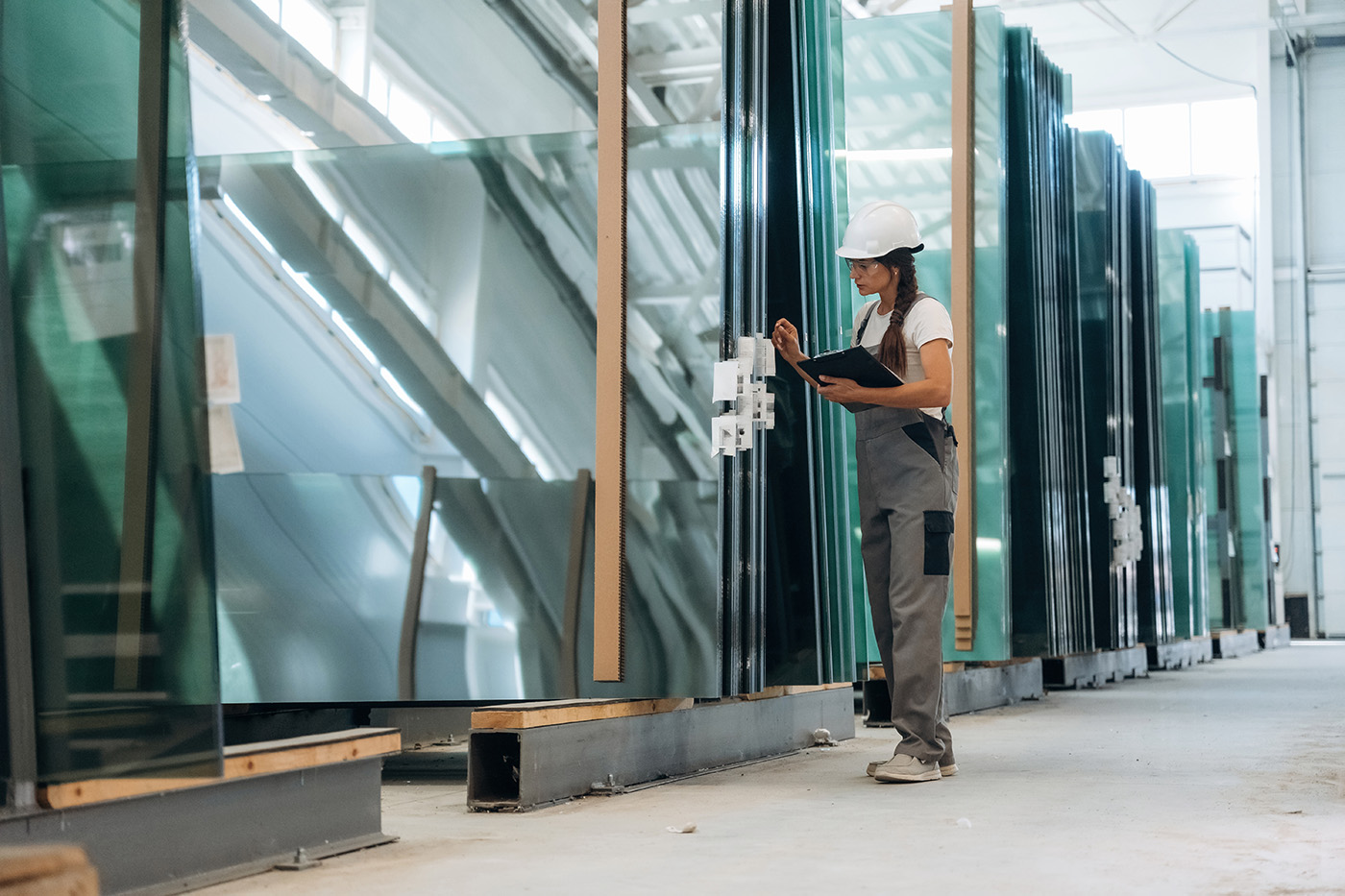
Challenges in Glass Production and Storage Processes
- Stock Losses and Unfindable Products: Production and shipment delays caused by the inability to find the correct product among thousands of similar-looking glass plates.
- Incorrect Shipment and Time Loss: Time spent finding the right glass during shipment increased logistics costs and sometimes led to the wrong glass being loaded onto the vehicle.
- Inaccurate Stock Counting: Manual counting processes taking days and involving a high margin of error.
What Have We Achieved?
1. 100% Accurate Stock Counting and Rapid Shipment
The era of manual counting is over. With a single click on the software panel, it is possible to determine within seconds which glass is in which aisle and on which shelf in the factory. Occupancy rates in the warehouse and product locations have become monitorable with 100% accuracy.
2. Operational Agility
The time to locate a glass sheet on a shipment list has dropped from minutes to seconds. By guaranteeing that the right product is loaded onto the right vehicle, the “Incorrect Shipment” rate has been neutralized to zero.
Implemented Solution: UWB & RFID Hybrid Tracking Architecture
To automate the intra-facility tracking and stock management of giant glass plates, we established a hybrid infrastructure combining passive identification with high-precision positioning. At the start of the operation, we digitally identified each glass plate using low-cost and durable passive RFID tags. We then transformed forklifts and all glass-handling equipment in the field into smart data terminals using RFID readers, UWB tags, and our industrial gateway devices.
The system’s operating principle is based on the RFID reader on the forklift detecting the glass the moment it is picked up, instantaneously establishing a “Glass-Forklift Match” via the gateway. Our UWB tags, which draw energy directly from the forklift’s battery and generate continuous data, produce location information with 50 cm precision during this process, transferring the glass’s journey within the facility to a digital map.
The moment the forklift drops the glass at the designated location and the RFID signal is cut, our software records the last coordinate where the signal was lost as the current “stock location” of the glass. Consequently, while searching for glass in massive areas is eliminated, stock data is updated instantaneously and flawlessly without the need for human intervention.